
Overview
Brand Standards is a governance framework that gives corporate teams flexible, scalable control over messaging compliance across all locations. It ensures your brand voice, legal requirements, and marketing policies are consistently enforced—without requiring manual review of every message.
Core Value: Automate compliance at scale while maintaining the flexibility to customize rules by location, region, or organizational unit.
How Brand Standards Work
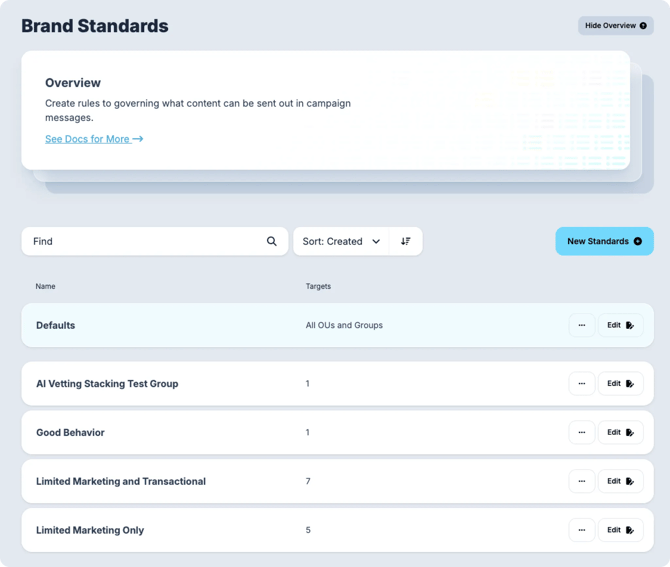
Brand Standards can be assigned to specific Target Groups, Collections, or Organizational Units (OUs). This allows you to create different rule sets for different segments of your business—franchises vs. corporate-owned locations, different regions with varying regulatory requirements, or pilot groups testing new messaging strategies.
Critical Rule: Each Target Group can only have ONE Brand Standard applied. If you attempt to assign a group that's already covered by another standard, the system will prompt you to remove it from the former assignment.
Section 1: Basic Brand Standards
Basic Brand Standards are foundational controls configured at the corporate level. These are binary or threshold-based rules that automatically enforce compliance across all messages sent through Quick Blasts.
Available Controls
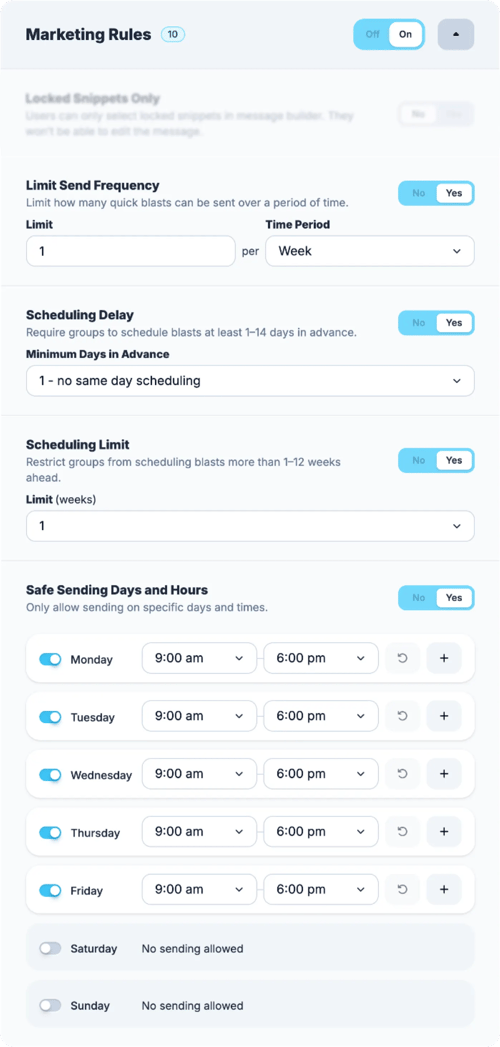
Block Images (Yes/No)
Prevents users from including images in their messages. Useful for ensuring text-only compliance or reducing message size/cost.
Block Files (Yes/No)
Prevents users from attaching files to messages. Common in environments where file sharing creates compliance or security risks.
Limit Emoji Usage (Yes/No + Quantity)
When enabled, restricts the maximum number of emojis allowed in a single message. Define the exact count (e.g., max 3 emojis). Helps maintain professional tone while still allowing some personality.
Limit Segment Count (Yes/No + Quantity)
SMS messages are split into segments (typically 160 characters each). This control caps how many segments a single message can consume, preventing unnecessarily long or costly messages.
Limit Character Count (Yes/No + Quantity)
Sets a hard character limit for messages (e.g., max 500 characters). Useful for enforcing brevity or staying within platform constraints.
Block Words (Yes/No + Word List)
Prevents the use of specific words or phrases. Words are case-insensitive. Use this to block prohibited language, competitor mentions, or terms that violate regulations (e.g., "free," "guaranteed," "cure").
Scheduling & Send Timing Controls
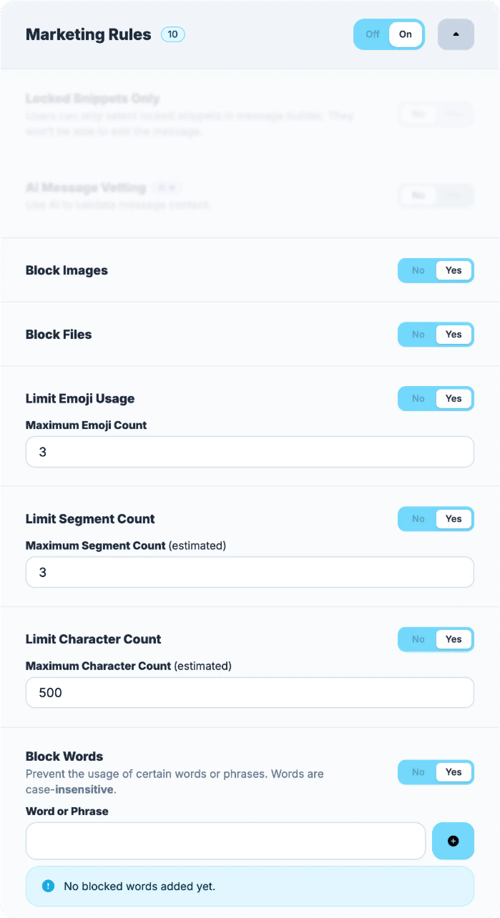
Limit Send Frequency (Yes/No + Limit + Time Period)
Caps how many Quick Blasts can be sent over a defined period (weekly or monthly). Example: Limit to 4 blasts per month to avoid over-messaging customers.
Limit Send Frequency (Yes/No + Limit + Time Period)
Caps how many Quick Blasts can be sent over a defined period (weekly or monthly).
Scheduling Delay (Yes/No + Minimum Days in Advance)
Requires users to schedule blasts at least 1–14 days in advance. This creates a buffer for corporate review or operational planning.
Scheduling Limit (Yes/No + Weeks Ahead)
Restricts how far in advance users can schedule blasts (1–12 weeks). Prevents scheduling conflicts or stale messaging.
Safe Sending Days and Hours (Yes/No + Time Windows)
Define specific days of the week and time ranges when messages can be sent. Protects customers from late-night or weekend messages while ensuring compliance with best practices.
Section 2: Locked Snippets
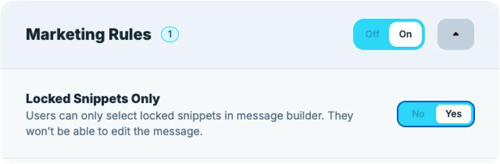
Locked Snippets take governance a step further by restricting users to pre-approved message templates. When enabled, users can only select from a library of corporate-created snippets—they cannot edit the content.
How It Works
When "Locked Snippets Only" is enabled for a Brand Standard, the message builder experience changes:
- Users select from approved snippet templates instead of writing free-form messages
- The message content is locked and cannot be edited
- The following Basic Brand Standard controls become irrelevant and are hidden: Block Images, Block Files, Limit Emoji Usage, Limit Segment Count, Limit Character Count, Block Words
Why? Because the content is pre-approved, there's no need to enforce these rules—compliance is already guaranteed by the snippet design.
Creating Locked Snippets
Locked Snippets are defined in the Snippet Templates section of corporate settings. Each template includes:
- Name: Internal identifier for the snippet
- Description: Explains the purpose or use case (e.g., "Promote XXX discount on services scheduled during weekends")
- Message Content: The pre-written text, which may include dynamic fields
- Field Customization: Define which fields (if any) users can customize (e.g., discount percentage, time windows)
- Group Access: Control which Target Groups can access this snippet template
Best Practice: Use Locked Snippets for high-risk messaging (legal disclosures, promotional claims) or when you want absolute consistency across locations.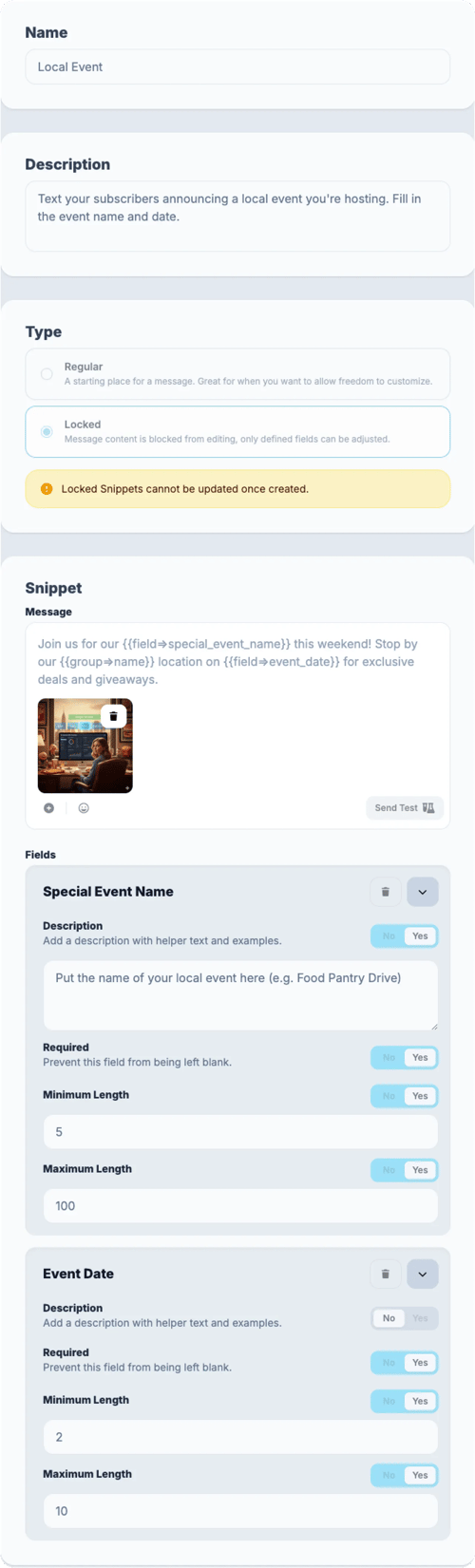
Section 3: AI Blast Vetting
AI Blast Vetting is the most sophisticated compliance layer. It uses AI agents—each powered by a custom prompt—to evaluate every message before it's sent. If a message violates one of the assigned agents' rules, the system returns a "Block" or "Warning" callout directly in the Quick Blast message builder.
How It Works
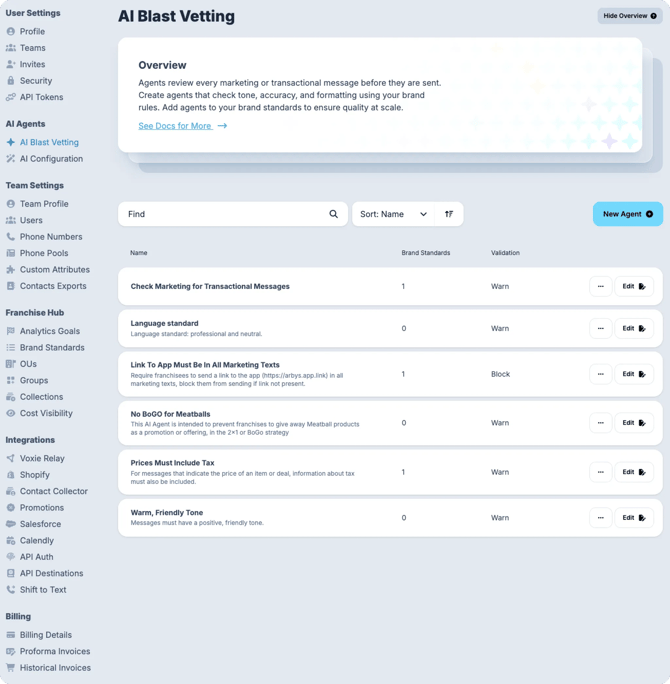
- Corporate configures AI Agents in the AI Blast Vetting settings. Each agent is a distinct compliance rule expressed as a prompt (e.g., "Check if marketing messages include BOGO offers," "Ensure tax information is disclosed in pricing").
- Agents are assigned to Brand Standards. You select which agents apply to which standard, and those agents are inherited by all Target Groups using that standard.
- Messages are evaluated in real-time. When a user drafts a Quick Blast, the AI runs all assigned agents against the message content. If any agent triggers, the user sees a callout explaining the issue.
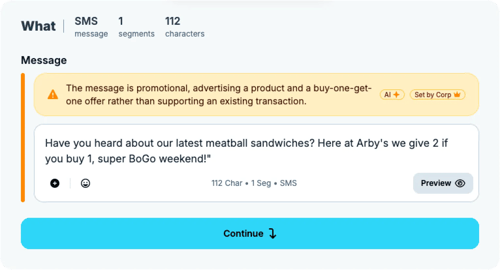
Example: AI Agent in Action
Agent: "Check Marketing for Transactional Messages"
Prompt Logic: Detects if a message contains promotional language (BOGO, discount, sale) and flags it as marketing rather than transactional.
User Message:
"Have you heard about our latest meatball sandwiches? Here at Arby's we give 2 if you buy 1, super BoGo weekend!"
AI Response:
⚠️ "The message promotes a product and includes a buy-one-get-one deal, which is marketing rather than transactional."
Tagged: AI ⚡ | Set by Corp 👑
Configuring AI Agents: Prompt Design & Best Practices
Each AI Agent is defined by a prompt that instructs the AI model on what to look for and how to respond. The quality of your compliance enforcement depends entirely on how well these prompts are written.
Anatomy of an Effective AI Agent Prompt
A strong prompt includes three components:
- Detection Criteria: What specific content or pattern should trigger this agent?
- Context/Reasoning: Why does this matter? What policy or regulation is being enforced?
- User Guidance: What should the user understand or do differently?
Example: Well-Structured Agent
Agent Name: "Prices Must Include Tax"
Prompt:
Analyze the message for any mention of prices, costs, discounts, or deals.

If the message includes a price (dollar amounts, percentage discounts, "buy one get one" offers, etc.) but does NOT explicitly state that tax is included or must be added, flag this message.

Reason: Legal compliance requires that all promotional messaging disclose tax information to avoid misleading customers about final costs.

Provide feedback that clearly explains: "For messages that indicate the price of an item or deal, information about tax must be included."
Why This Works:
- Specific detection logic: Covers various price formats (dollar amounts, percentages, BOGO)
- Clear compliance rationale: Links to legal requirements
- Actionable feedback: Tells users exactly what's missing
Prompt Writing Recommendations
Be Specific, Not Vague
❌ Weak Prompt: "Check if the message sounds unprofessional"
✅ Strong Prompt: "Flag messages that contain profanity, excessive exclamation points (more than 2), or all-caps words (except standard acronyms like BOGO, ASAP)"
Define Edge Cases
Your prompt should account for legitimate exceptions:
❌ Weak Prompt: "Block any message mentioning competitors"
✅ Strong Prompt: "Flag messages that explicitly promote a competitor's product or service, or disparage a competitor. Do NOT flag messages that simply reference a competitor as a location reference (e.g., 'We're located next to [Competitor]')"
Use Examples in Your Prompts
Help the AI model understand nuance by providing examples directly in the prompt:
Flag messages that make medical or health claims about products.

Examples of violations:
- "Our salad will help you lose weight"
- "This smoothie boosts your immune system"
- "Clinically proven to reduce cholesterol"

NOT violations:
- "Fresh ingredients you'll feel good about"
- "Packed with protein"
- "Made with real fruit"
Separate Detection from Enforcement
Write prompts that focus on identifying the issue, not on whether it should warn or block. The validation level (warn vs. block) is set separately in the configuration—this keeps your prompts reusable and easier to maintain.
Validation Levels: Warning vs. Block
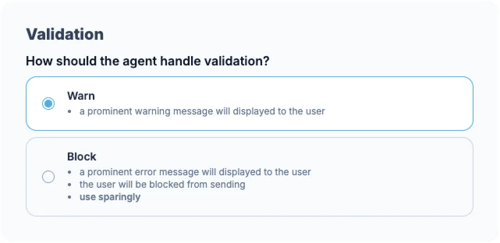
Every AI Agent is configured with a Validation level that determines what happens when the agent triggers:
⚠️ Warning (Soft Enforcement)
- The message is flagged with a yellow callout
- Users see the compliance issue but can choose to proceed anyway
- The message can still be sent—the warning is educational, not restrictive
🚫 Block (Hard Enforcement)
- The message is flagged with a red callout (or blocks the send button entirely)
- Users cannot proceed until they fix the issue
- The message must be revised before it can be sent
When to Use Warnings vs. Blocks
Use Warnings For:
✅ Subjective or Stylistic Issues
Example: "Warm, Friendly Tone" agent that suggests softening overly formal language. Users should have discretion here.
✅ Context-Dependent Rules
Example: "Link To App Must Be In All Marketing Texts" might not apply to every situation (e.g., time-sensitive local event). A warning lets users override when appropriate.
✅ Educational Compliance
Example: "Language Standard" agent that flags informal phrasing or slang. This educates users on best practices without blocking their ability to communicate.
✅ Pilot or Experimental Agents
When testing a new compliance rule, start with warnings to gather data on how often it triggers and whether it's catching the right issues. Graduate to blocking once you've validated the logic.
Use Blocks For:
🚫 Legal or Regulatory Requirements
Example: "Prices Must Include Tax" when operating in jurisdictions where this is legally mandated. No room for interpretation—block the message.
🚫 Brand Safety Violations
Example: "No RoGo for Meatballs" agent that prevents franchisees from giving away a specific promotion on certain products. This is a hard business rule that can't be violated.
🚫 High-Risk Content
Example: Agent that blocks medical claims ("cures," "treats," "FDA-approved"). These create liability and must be stopped at the source.
🚫 Zero-Tolerance Policies
Example: Agent that blocks profanity, discriminatory language, or content that could create hostile interactions with customers.
Practical Examples: Warning vs. Block in Action
Example 1: Marketing Classification (Warning)
Agent Name: "Check Marketing for Transactional Messages"
Validation: Warn
Reasoning: Users might be sending legitimate hybrid messages (e.g., "Your appointment is confirmed—while you're here, ask about our new service"). A warning prompts them to reconsider their categorization without blocking a valid use case.
User Experience: Yellow callout appears with explanation. User can proceed if they determine the message is appropriately categorized.
Example 2: Tax Disclosure (Block)
Agent Name: "Prices Must Include Tax"
Validation: Block
Reasoning: Legal compliance is non-negotiable in certain regions. Sending a message without tax disclosure creates liability.
User Experience: Red callout appears. Send button is disabled until the message is revised to include tax information (or the price reference is removed).
Example 3: Friendly Tone (Warning)
Agent Name: "Warm, Friendly Tone"
Validation: Warn
Reasoning: Brand voice guidelines prefer a warm, conversational tone, but there are legitimate situations where formal language is appropriate (e.g., service issue resolutions).
User Experience: Yellow callout suggests reconsidering phrasing. User can acknowledge the feedback and proceed if the tone is intentional.
Stacking Multiple AI Agents
Brand Standards can use multiple AI agents simultaneously. Each message is evaluated against all assigned agents, and users see every triggered warning or block in a single view.
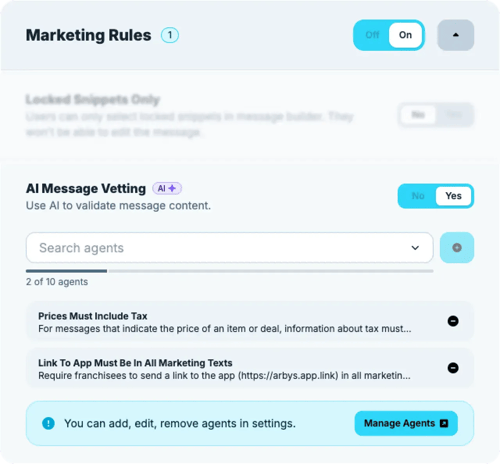
Strategic Stacking:
- Layer general + specific rules: Start with broad agents (e.g., "Language Standard") and add targeted ones (e.g., "Prices Must Include Tax") for nuanced enforcement
- Balance warnings and blocks: Don't overwhelm users with 8 blocking agents—use warnings for guidance, blocks for critical issues
- Organize by risk level: High-risk markets or franchises get more agents; low-risk segments get baseline coverage
Example Stack for High-Compliance Market:
- "Prices Must Include Tax" — Block
- "Link To App Must Be In All Marketing Texts" — Block
- "Check Marketing for Transactional" — Warn
- "Language Standard" — Warn
- "Warm, Friendly Tone" — Warn
This gives 2 hard stops on legal/policy requirements, 3 educational prompts on best practices.
Advanced Prompt Engineering Tips
Use Conditional Logic in Prompts
If the message contains pricing information (dollar amounts, percentages, "free," "discount"):
  Check if tax information is disclosed
  If not disclosed → Flag

If the message does NOT contain pricing:
  Do not flag (this agent doesn't apply)
This prevents false positives and makes agents more precise.
Train the AI on Your Brand Voice
Include your actual brand guidelines in the prompt:
Our brand voice is:
- Conversational and warm, not corporate or stiff
- Inclusive and welcoming to all customers
- Focused on benefits, not just features
- Honest and transparent—no hype or exaggeration

Flag messages that feel overly salesy, use clichés, or don't align with these principles.
Iterate Based on Real Usage
Monitor which agents trigger most often and whether users are overriding warnings. If an agent warns constantly but is always ignored, either:
- The prompt needs refinement (too broad, catching false positives)
- The rule isn't actually valuable (turn it off)
- It should be escalated to a block (users are consistently violating policy)
Key Takeaways: AI Agent Design
1. Warnings educate; Blocks enforce. Use warnings for gray areas, blocks for black-and-white rules.
2. Prompt quality determines compliance quality. Invest time in writing specific, example-rich prompts with clear detection criteria.
3. Start conservative, then tighten. Launch new agents as warnings, validate their accuracy, then upgrade to blocks once you're confident.
4. Stack strategically. More agents ≠ better compliance. Focus on high-impact rules and avoid overwhelming users with excessive warnings.
5. Agents should explain, not just reject. Every callout should help users understand why their message was flagged and how to fix it.
Assigning Brand Standards to Targets
Brand Standards are applied through the Targets interface. You can assign a standard to:
- Individual Target Groups (specific locations or franchises)
- Collections (pre-grouped sets of Target Groups)
- Organizational Units (OUs) (hierarchical segments of your business)

Assignment Rules
- Each Target Group can only belong to one Brand Standard at a time
- If you attempt to assign a group that's already in another standard, the system will prompt you to remove it from the previous assignment
- Bulk assignment via OUs or Collections simplifies management—change the standard once, apply to hundreds of locations
Best Practice: Use a "Defaults" standard for baseline compliance across all groups, then create specialized standards for high-risk segments (e.g., franchises with stricter regulations, pilot programs with looser rules).
Key Takeaways
Flexibility: Brand Standards adapt to your business structure. Create as many standards as you need, assign them granularly, and modify them as policies evolve.
Layered Compliance: Combine Basic Controls, Locked Snippets, and AI Vetting to create the exact level of governance each segment requires.
Scalability: Automate enforcement across thousands of locations without manual review. AI Vetting handles nuanced rules; basic controls handle simple ones.
User Experience: Compliance happens in-context. Users see errors and warnings immediately, learn why content is blocked, and can fix issues before wasting time.